
A changing conversation in breast augmentation
Breast augmentation is currently going through an important evolution.
Over the past several years, increasing numbers of individuals have become interested in above-the-muscle implant placement, and for many patients this approach can provide excellent results.
At the same time, this shift has also created an important question:
Does this mean that under-the-muscle breast augmentation is no longer necessary?
The answer is no.
While above-the-muscle techniques have become increasingly popular, there are still situations where traditional subpectoral, or below-the-muscle, placement remains an excellent option.
The key is understanding that breast augmentation is not a one-size-fits-all procedure. The most appropriate approach often depends on your anatomy and the characteristics of your breast tissue.
Why some individuals may still benefit from under-the-muscle placement
One of the most important factors when planning breast augmentation is the amount of natural soft tissue present in the breast.
If you are naturally very thin or have less soft tissue coverage in the upper portion of the breast, placing an implant above the muscle may increase the likelihood of seeing or feeling the edges of the implant.
In certain situations, there may also be a greater risk of visible implant shadowing.
For these individuals, placing the implant beneath the pectoralis major muscle can still provide meaningful advantages.
The muscle offers additional coverage over the upper part of the implant, helping create a softer transition and reducing the visibility of the implant in patients with limited natural tissue.
This is why under-the-muscle placement continues to have an important role today.
The decision is not about choosing the newest technique. It is about selecting the approach that best fits your anatomy.
Modern under-the-muscle augmentation is more sophisticated than it once was
When people hear the term “under the muscle,” they often imagine that the entire implant sits completely beneath the pectoralis muscle.
In reality, modern breast augmentation is often more nuanced than that.
One of the challenges with traditional subpectoral placement is that the pectoralis muscle can sometimes hold the implant slightly too high on the chest.
Ideally, the implant should sit naturally within the lower portion of the breast.
Another consideration is that when the implant remains fully beneath the muscle, muscle contraction may create some degree of breast distortion during activities that involve flexing the chest muscles.
For this reason, the way the muscle is managed becomes extremely important.
Understanding the combination pocket approach
To address these concerns, Dr. Hammond often utilizes what he refers to as a combination pocket approach.
In simple terms, this involves carefully releasing the lower border of the pectoralis muscle.
Rather than covering the entire implant, the muscle ultimately covers only the upper portion of the implant, while the lower portion remains in contact with the breast tissue itself.
This creates a balance between support and shape.
The upper third of the implant benefits from the additional coverage provided by the muscle, while the lower two-thirds of the implant are allowed to sit more naturally within the breast.
This approach provides several advantages.
First, it allows the implant to settle slightly lower into the breast, helping create a more anatomical position rather than allowing the muscle to hold the implant excessively high.
Second, it allows the implant to express its projection more naturally, helping restore fullness within the lower portion of the breast.
The result is often a breast shape that feels more balanced and harmonious with the natural anatomy.
What about animation deformity?
One of the most commonly discussed considerations with subpectoral augmentation is animation deformity.
Because part of the implant remains associated with the pectoralis muscle, some movement may still occur when the chest muscles are flexed.
Typically, this may appear as a slight widening between the breasts or subtle temporary changes in breast shape during muscle contraction.
Importantly, the degree of movement is often significantly reduced with a combination pocket approach compared with more traditional under-the-muscle techniques.
It is also important to keep this finding in perspective.
As Dr. Hammond frequently explains, most individuals are not significantly bothered by this degree of movement and do not consider it a major concern in everyday life.
Rather, it becomes one of several factors that should be discussed when determining which implant position may be most appropriate for your situation.
Why anatomy should guide the decision
One of the most important messages in modern breast augmentation is that there is rarely one universally correct technique.
Some individuals may be excellent candidates for above-the-muscle placement.
Others may continue to benefit from subpectoral augmentation because of their tissue characteristics and natural anatomy.
Factors that influence this decision include:
- The amount of soft tissue coverage
- Breast thickness
- Chest wall anatomy
- Implant visibility concerns
- Long-term aesthetic considerations
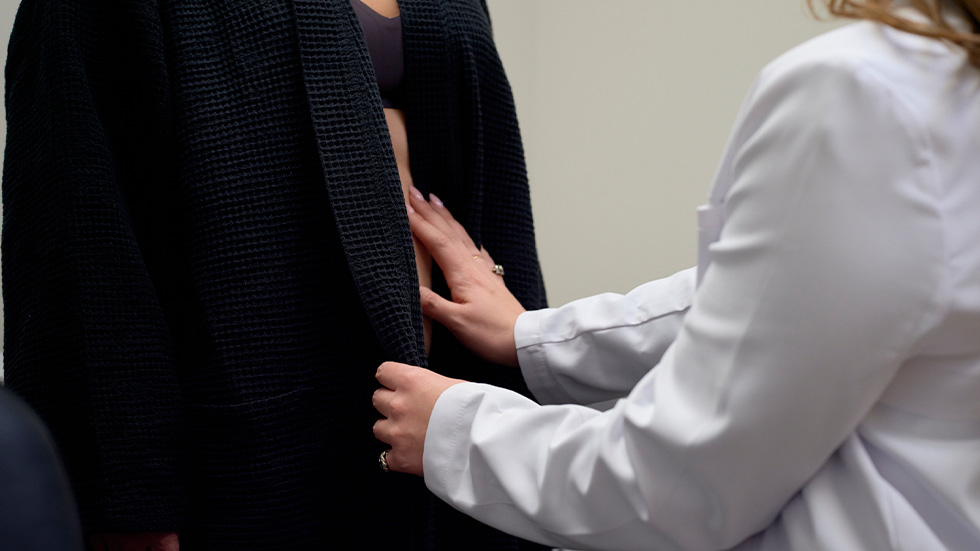
This is why consultation remains such an important part of the process.
Rather than beginning with a specific technique in mind, the conversation often begins with understanding your anatomy and identifying which approach is most likely to provide a natural and balanced result.
Constructing a plan around your anatomy
Breast augmentation continues to evolve, and today’s surgical techniques offer more options than ever before.
At the same time, the increasing popularity of one technique does not automatically make another approach obsolete.
Under-the-muscle augmentation continues to remain an excellent option for selected individuals, particularly when additional implant coverage is needed.
The important question is not whether above-the-muscle or below-the-muscle placement is universally better.
The more meaningful question is:
Which approach makes the most sense for your anatomy?
By carefully evaluating your tissue characteristics, breast shape, and overall anatomy, a surgical plan can be developed that reflects your individual needs rather than following a standardized approach.
This individualized planning remains one of the most important aspects of breast augmentation and helps ensure that implant placement is selected not according to trends, but according to what is most appropriate for you.